 EN
EN



Exam & Proctoring
For simpler, more secure exam proctoring
Interviewing
For quick, confident, and bias-free talent decisions
AI Agents and Add-ons
Smart Tools for Enhanced Automation and Productivity
For simpler, more secure exam proctoring
For quick, confident, and bias-free talent decisions
Smart Tools for Enhanced Automation and Productivity
AI surveillance in online exams revolutionizes the monitoring and analysis of examinee behaviors, aiming to maintain integrity and fairness in remote assessment processes. Through sophisticated algorithms and advanced techniques, AI exam monitoring not only detects but also prevents potential instances of academic dishonesty. It stands as a constant, consistent layer of oversight, scrutinizing digital interaction so the sanctity of online exams remains intact.
Exam surveillance powered by AI refers to the use of artificial intelligence technologies to monitor and analyze behavior during online exams, with the aim of detecting possible instances of cheating. It involves deploying an AI proctoring system capable of spotting suspicious patterns and behaviors exhibited by test takers, well beyond what a single human proctor watching a video feed could track consistently across hundreds or thousands of candidates at once.

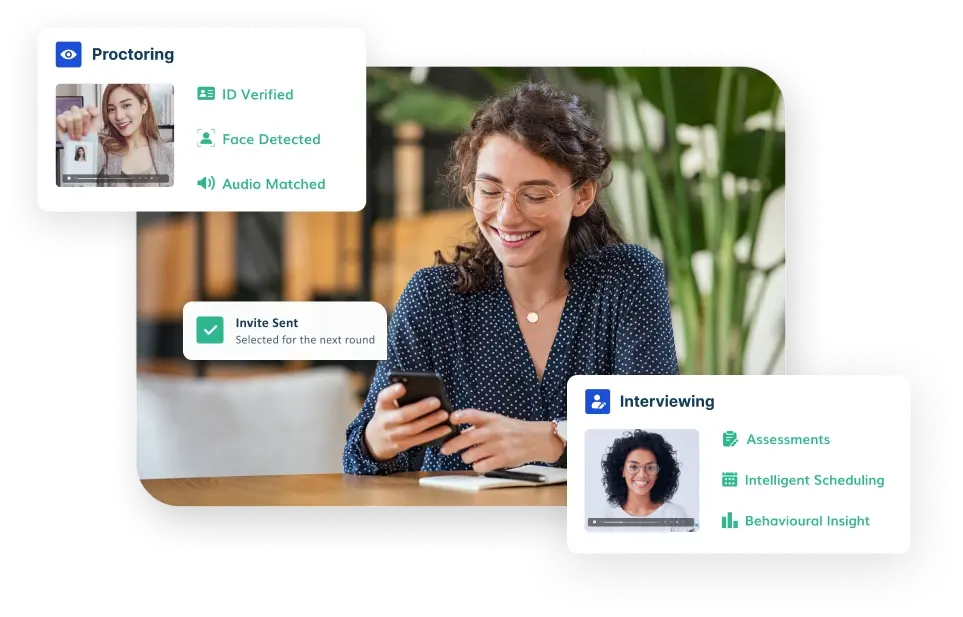
AI surveillance systems use techniques such as facial recognition, keystroke analysis, eye tracking, and machine learning to monitor and analyze test-taker behavior during online exams. These systems continuously gather data and compare it against predefined criteria to identify potential instances of cheating, flagging anomalies for human review rather than making automatic decisions.
This is an increasingly common question, since a growing share of exam misconduct today involves candidates using AI chatbots for answers rather than traditional methods like hidden notes. Modern AI surveillance addresses this in a few ways:
The push toward stronger exam supervision isn't hypothetical. In 2026, Princeton University's faculty voted to require in-person proctoring for exams for the first time in over a century, specifically citing a rise in students using AI tools to cheat as the reason for the change. Cases like this reflect a broader shift across higher education and professional certification: institutions that once relied on trust-based honor codes are re-evaluating that approach now that AI has made undetected cheating significantly easier without some form of active monitoring. AI surveillance exists precisely to give institutions that oversight without reverting to costly, hard-to-scale in-person invigilation for every exam.
A fair question institutions ask before adopting AI surveillance is how the cost stacks up against manual, human-led monitoring. At a high level:
For institutions running large-scale or recurring exams, the cost gap between manual and AI-based monitoring tends to widen significantly as candidate volume grows, which is why AI surveillance has become the default for high-volume certification and recruitment testing.
Q: Is AI surveillance in online exams legal?
A: Yes, AI surveillance is legal, provided it complies with data privacy regulations and is transparently implemented, with clear disclosure to candidates about what is monitored and why.
Q: Can AI surveillance systems differentiate between intentional cheating and unintentional mistakes?
A: Yes. AI surveillance systems are designed to analyze behavior patterns and flag anomalies for human review rather than making an automatic call, which is exactly how intentional cheating gets distinguished from an innocent mistake like briefly looking away from the screen.
Q: How accurate are AI surveillance systems in detecting cheating behaviors?
A: AI surveillance systems leverage advanced algorithms to achieve high accuracy in detecting cheating behaviors, although they may occasionally produce false positives that require human review before any action is taken.
Q: Are there privacy concerns associated with AI surveillance in online exams?
A: Privacy concerns can arise from the collection and analysis of examinee data. Transparent implementation, clear data retention policies, and adherence to data privacy regulations address most of these concerns.
Q: How does the cost of AI surveillance compare to manual proctoring?
A: AI surveillance typically has a lower cost per candidate at scale than manual monitoring, since one system can monitor many candidates at once, with human reviewers focused only on flagged incidents rather than every session.
Q: Can AI surveillance detect candidates using ChatGPT or other AI tools to cheat?
A: Yes, to a meaningful extent. Behavioral pattern analysis, browser and process monitoring, and environment checks are specifically designed to catch signs of AI-assisted cheating, not just traditional methods like hidden notes.
.svg "webcam (1)")

.svg "robot (1)")